
On Knowledge, Openness, and the Possibility of Looking Again
There is a subtle difference between having knowledge and remaining open to what is actually happening.
Knowledge is indispensable.
It allows us to remember, compare, predict, communicate, recognize patterns, develop skills, and make decisions. Without it, ordinary life would barely function.
But knowledge has a strange tendency.
What begins as:
This is what I currently understand.
can quietly become:
This is simply how things are.
That shift is the central concern of this essay.
The problem is not knowledge.
The problem is premature closure: the moment when an interpretation becomes settled before we have good enough reason to stop looking.
A simple contrast captures the movement:
Knowledge says: “I know.”
Seeing says: “Let me look.”
1. Knowledge and Closure
Knowledge does not necessarily prevent us from seeing.
Quite often, it allows us to see more.
A doctor notices significance in a symptom that another person may overlook.
A musician hears structure inside a piece of music that an untrained listener may not distinguish.
An astronomer looks at a point of light and recognizes relationships, processes, and timescales that another observer may never notice.
Knowledge does more than provide additional facts.
Knowledge changes what becomes visible to us.
It directs attention.
It creates distinctions.
It changes what appears significant.
This happens in ordinary work as well.
Imagine someone learning a complicated technical system. At first, an incident may look like a wall of unfamiliar error messages, dependencies, permissions, and processes.
Months later, the same person may immediately notice that one particular error is unusual.
Knowledge has changed what stands out.
But the same knowledge can also become a source of blindness.
Suppose an experienced technician has encountered the same error twenty times. Usually, the cause is the same.
The twenty-first time, the technician sees the familiar message and thinks:
I already know what this is.
That knowledge is useful. It creates a reasonable first hypothesis.
But if investigation stops there, a different underlying cause may be missed simply because the surface looked familiar.
Experience helped them see quickly. Certainty stopped them seeing further.
That is the difference between knowledge with openness and knowledge with closure.
There is an important distinction between:
This is what the evidence currently suggests.
and:
This is what it must be.
The first can guide investigation.
The second ends it.
The same movement occurs outside technical problems.
We conclude:
I know what this person is like.
I know how this situation will end.
I know what I am capable of.
These judgments may contain truth.
The question is not whether conclusions should exist.
The question is:
Does the conclusion help us understand what we encounter, or has it begun preventing anything new from being taken seriously?
A conclusion can guide us.
Or it can become a wall.
2. What Does It Mean to See?
It would be tempting to imagine that beneath thought and interpretation there exists some perfectly pure form of perception called seeing.
But human beings do not encounter the world that way.
Perception is already shaped.
The nervous system organizes sensory information.
Attention selects.
Memory influences recognition.
Emotion changes significance.
Language creates categories.
Expectations influence what is noticed.
Culture shapes what appears important.
Knowledge changes what becomes salient.
Imagine three people entering the same forest.
One sees trees.
A botanist notices species, disease, age, soil conditions, and patterns of growth.
A carpenter notices grain, structure, damage, and the physical qualities of the wood.
A child becomes fascinated by a knot in the bark that resembles a face.
The forest is shared.
What becomes visible within it is not.
There may therefore be no completely neutral experience hiding beneath interpretation.
Seeing cannot mean escaping interpretation altogether.
It means something more modest:
Seeing means remaining sufficiently open that further experience and evidence can challenge and revise our interpretation.
This does not require a blank mind.
It does not require abandoning concepts.
It does not require distrusting everything one already knows.
It means that interpretation remains revisable.
Suppose someone appears distant and unfriendly. Repeated encounters seem to support that judgment.
Later, a longer conversation reveals intense shyness.
The original interpretation was not necessarily foolish. It was a reasonable conclusion from limited evidence.
But something new has entered.
Seeing means allowing it to matter.
I thought I understood.
Perhaps I need to look again.
A conclusion may be strong.
It may be supported by years of experience.
It may be the best explanation currently available.
And still there can remain some possibility of revision.
Without that possibility, knowledge begins filtering experience rather than learning from it.
3. The Map and the Landscape
Knowledge can be thought of as a map.
Maps are useful precisely because they simplify.
They leave things out.
A road map does not contain every stone beside the road.
A scientific model does not reproduce every property of the phenomenon it describes.
A memory does not contain the original event.
A description does not contain the thing described.
A self-image does not contain the whole living person.
A map reduces complexity into something usable.
That is its strength.
And its limitation.
Knowledge provides the map. Seeing remembers that the map is not the landscape.
Imagine driving the same route every morning for years.
At first, the surroundings require attention.
Eventually, the journey becomes mentally compressed into:
the way to work
Then one morning the usual road is closed.
Suddenly attention wakes up.
Side streets that have been passed hundreds of times become visible.
A road that previously meant nothing becomes important.
The landscape did not suddenly appear.
The familiar map simply stopped being sufficient.
But the relationship works in both directions.
Maps do not merely describe landscapes.
They change what becomes visible within them.
Learning the history of a city changes a walk through its streets.
An ordinary wall may become evidence of an ancient boundary.
A strangely curved street may reveal the shape of something that disappeared centuries ago.
The buildings have not changed.
Knowledge has changed their significance.
This is the deeper relationship between seeing and knowledge:
knowledge guides attention
↓
experience and evidence may challenge interpretation
↓
understanding changes
↓
new understanding changes what becomes visible
The map influences how we encounter the landscape.
The landscape gives us reasons to redraw the map.
Knowledge can therefore both reveal and obscure.
The expert sees distinctions invisible to the beginner.
But expertise has its own danger: familiarity can slowly turn observation into assumption.
The beginner lacks depth but possesses freshness.
The expert has depth.
The beginner has freshness.
Perhaps the ideal is:
the knowledge of the expert with the openness of the beginner.
To be capable of saying:
I have seen many things like this.
while still asking:
But what is actually happening here?
4. When Openness Becomes Another Dogma
There is an irony inside any philosophy of openness.
The philosophy itself can become another form of closure.
One may conclude:
I must always remain open.
I should never judge.
I must remain present.
I should stop thinking so much.
I need to see things correctly.
What began as an invitation to look becomes another psychological rule.
Meditation offers a simple example.
Someone begins meditating partly to observe thought without being continuously carried away by it.
Soon another layer appears:
My mind is too busy.
I am bad at meditation.
I should be calmer by now.
Now the attempt to observe experience has produced a new ideal against which experience is measured.
The mind begins monitoring itself:
Am I present enough?
Am I thinking too much?
Have I lost the state?
Openness has become another achievement.
Another standard.
Another map pretending to be the landscape.
This reveals something important:
Seeing cannot be maintained through psychological force.
Closure will happen.
Assumptions will form.
Habits will return.
Thought will repeat itself.
That is not failure.
The important possibility is reopening.
One notices:
I had already decided what this was.
Then:
Let me look again.
One notices:
I am trying desperately to remain open.
That too can be examined.
Seeing does not require perfection.
It requires the possibility of reopening.
5. Openness Without Indecision
But reopening does not mean refusing to conclude.
That would turn intellectual humility into paralysis.
Some conclusions must guide action.
A bridge may be unsafe.
A treatment may be ineffective.
A hypothesis may fail.
A boundary may need to be set.
A decision may have to be made before complete certainty is possible.
Imagine smelling smoke in a hotel corridor.
Perhaps someone has burned food.
Perhaps there is a minor electrical problem.
Perhaps the building is on fire.
Openness does not mean standing in the corridor indefinitely appreciating the uncertainty of the situation.
One acts.
Leave the building.
Investigate from safety.
Revise the interpretation afterward if necessary.
This points toward a position between absolute certainty and endless doubt:
provisional commitment
One acts upon the best understanding currently available while remaining capable of revision when new evidence gives good reason to reconsider.
This is how competent action often works.
Certainty is not always required.
Sufficient confidence is.
And revision does not necessarily mean the earlier decision was foolish.
The earlier decision may have been entirely reasonable given what was known at the time.
A conclusion can therefore be firm without pretending to be absolute.
It can say:
Given what I currently understand, this is how I will act.
without saying:
Nothing could ever make me reconsider it.
This is neither indecision nor blind certainty.
It is provisional commitment.
Perhaps the mature relationship to knowledge is simply:
This is what I currently understand, and I am still willing to look.
6. Wonder
Wonder may be one of the consequences of this openness.
The familiar world is usually compressed by recognition.
A tree becomes:
tree
Rain becomes:
weather
A face becomes:
someone I know
A room becomes:
the room
Recognition is efficient.
It has to be.
But familiarity can create an illusion.
Because something has been named, we begin to feel that it has been exhausted.
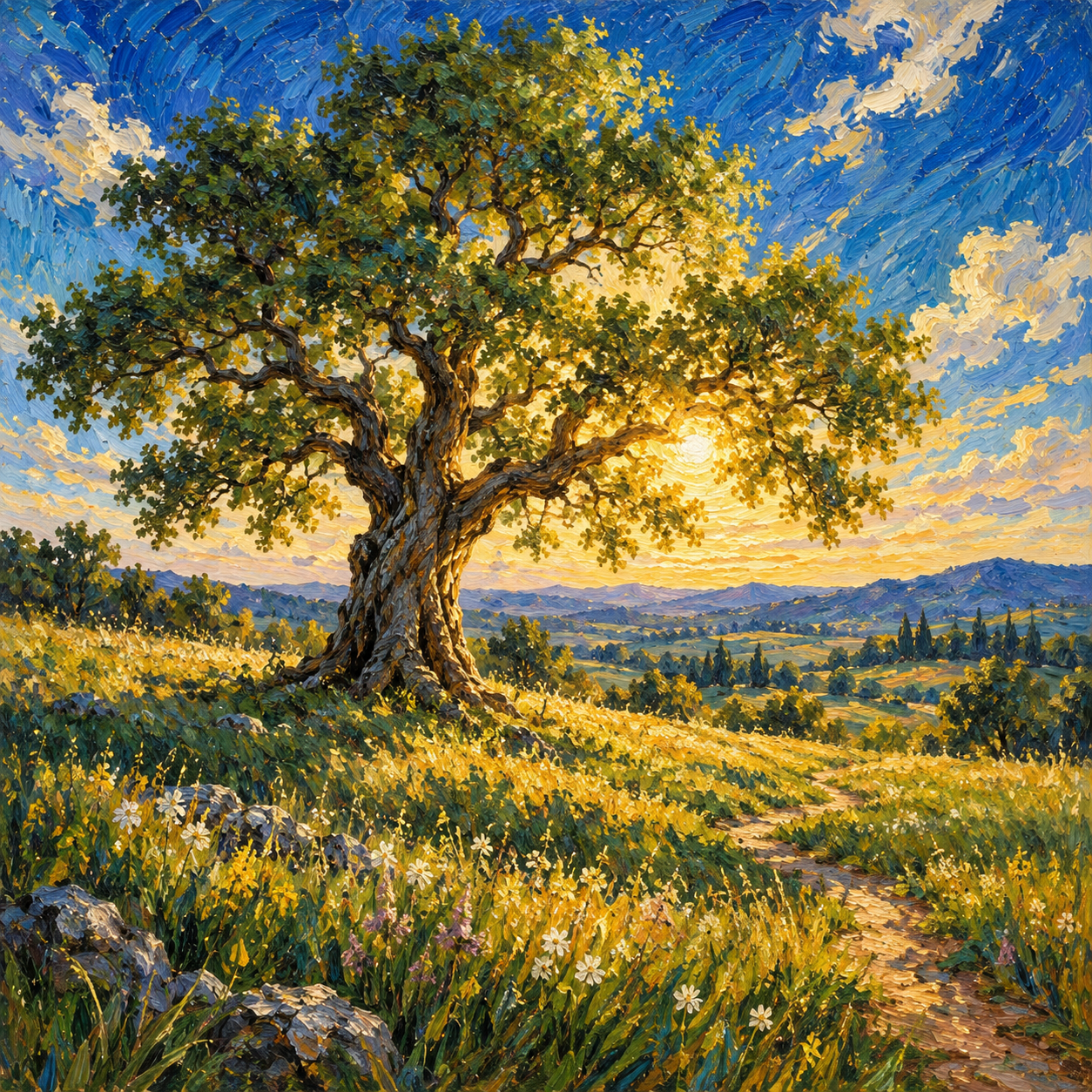
Imagine walking past the same tree every day.
For years it is simply:
that tree beside the path
Then one afternoon attention slows.
The bark is full of cracks, scars, moss, insects, and different shades of color.
Branches move continuously in the wind.
New leaves appear beside dead wood.
Roots lift the pavement.
Light passes differently through every layer of the crown.
The tree has not suddenly become more complex.
The map simply loosened enough for more of the landscape to become visible.
The word tree contains almost nothing of the tree.
Wonder appears when familiarity stops being the final word.
And wonder does not require ignorance.
Knowledge can deepen it.
Understanding stellar distances need not make the night sky less astonishing.
Learning biology need not make a living organism less mysterious.
Understanding harmony can reveal structures in music that had previously gone unheard.
Knowledge can make the familiar unfamiliar again.
So wonder is not produced by knowing less.
It may emerge from knowing without closure.
There is also an important difference between wonder and excitement.
Excitement often contains:
More.
Wonder contains something closer to:
This.
Excitement reaches toward the next stimulus.
Wonder can remain with what is already here.
This need not even be dramatic.
Sometimes another person says something unexpected in an ordinary conversation, and for a moment the familiar image of them breaks open.
There is suddenly the realization that behind the face one knows exists an interior life that can never be completely mapped.
Nothing supernatural has happened.
Something familiar simply became larger than the knowledge that had contained it.
The Open Door
Perhaps the entire philosophy can be condensed into one principle:
The problem is not knowing something. The problem is believing that because we know something, there is nothing left to see.
Knowledge is necessary.
Interpretation is unavoidable.
Conclusions are necessary.
Action cannot wait forever for perfect certainty.
The aim is therefore not to eliminate knowledge, thought, judgment, or conclusion.
It is to use them without confusing them with an exhausted reality.
A map can be extraordinarily accurate and still remain a map.
It can guide action.
It can reveal what would otherwise remain invisible.
It can save us from getting lost.
And it can still require revision.
Perhaps wisdom lies in learning to move between map and landscape.
To know enough to act.
To remain open enough to revise.
To allow knowledge to sharpen perception without allowing familiarity to end inquiry.
To make conclusions without worshipping them.
To commit without pretending to possess certainty.
The movement is simple:
I know.
Do I really know?
Let me look.
I do not know. Let me look.
 theseersofnomaster.com